
Our Story
Lambton Heritage Museum celebrates the communities of Lambton County. We have seen over half a million visitors go through our doors since the museum opened May 13, 1978. The museum's original collection is based on the contribution of two private donors:
- Peter Eisenbach of Grand Bend was fascinated with the past from an early age. He had the foresight to gather tools and equipment that were becoming obsolete. In 1960, Eisenbach opened a private museum in Grand Bend. He later donated his artifacts to the County of Lambton.
- Fred Walden of Forest was a keen collector. He acquired local harvest equipment, crockery, pressed glass, and hand-coloured lithographs. Walden encouraged Lambton County Council to fund the initial building construction.
The collection continued to grow and now fills an extensive 50,000 square foot complex. It is home to more than 25,000 artifacts depicting the history of Lambton County. We protect these artifacts and display them for the public.
Owned and operated by the County of Lambton, we welcome residents and visitors to come discover our stories and incredible artifacts.
There are two main galleries as well as six historic buildings and two exterior exhibition halls. Our main galleries are open year round, and our outdoor buildings are open from May to October (weather permitting).
Acknowledgement of Ancestral Lands
Acknowledgement of Ancestral Lands Preamble:
We acknowledge that the Chippewa, Odawa, and Potawatomi peoples, referred to collectively as the Anishinaabeg, inhabited these lands at the time of transfer to the Crown by treaty. Lambton County was part of the Huron Tract Purchase, which was transferred under Treaty #29 in 1827, and also includes lands associated with the Sombra Township Purchase transferred under Treaty #7 in 1796, and Long Woods Purchase transferred under Treaty #21 in 1819. We also acknowledge the earlier Indigenous people who travelled these lands in the time of the Wampum treaties.
We acknowledge that we are all treaty people, with our own set of rights and responsibilities. Treaties are a foundational part of our society, and the settlement of Lambton County within a treaty area was made possible through the treaty process. The existence of treaties is proof that the first settlers of what is now Canada acknowledged First Nations as sovereign people and negotiated Nation to Nation. By understanding the colonial history of Canada we can renew our relationships with each other and move towards meaningful reconciliation.
Further, it is through the connection of the Anishinaabeg with the spirit of the land, water and air that we recognize their unique cultures, traditions, and values. Today, we are part of this same land that sustains all life, and it is the sacred responsibility of all people to ensure that the environment remains protected. Finally, we acknowledge that the inherent languages of the Anishinaabeg preclude any English/French meaning.
Acknowledgement of Ancestral Lands:
We acknowledge that this land on which we are gathered today is part of the ancestral land of the Chippewa, Odawa, and Potawatomi peoples, referred to collectively as the Anishinaabeg. It is through the connection of the Anishinaabeg with the spirit of the land, water and air that we recognize their unique cultures, traditions, and values. Together as treaty people, we have a shared responsibility to act with respect for the environment that sustains all life, protecting the future for those generations to come.
Language Pronunciations:
Anishinaabeg (ah-nish-i-nah-beg)
Chippewa (chip-uh-wah)
Odawa (o-dah-wah)
Potawatomi (pot-uh-wah-tuh-mee)
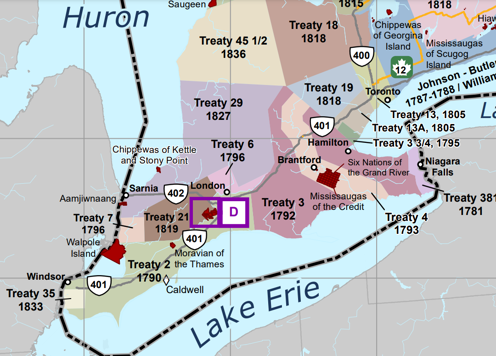
This map depicts a small portion of Southern Ontario and its treaties including all three treaties that span Lambton County: Treaty #7, Treaty #21, and Treaty #29.
This map also depicts all reserve lands that Lambton County encompasses: Aamjiwnaang First Nation, Kettle & Stony Point First Nation, and Walpole Island First Nation, Bkejwanong Territory.
This map was sourced from the Government of Canada, please visit the link to view the full treaty map of Ontario with the index.
Our Mission and Our Mandate
Our Mission
Lambton Heritage Museum tells the stories of Lambton County through the preservation and presentation of artifacts, culture and local history. We encourage the Lambton County community to experience their unique heritage through participatory museum programs and special events.
The County of Lambton Cultural Services Strategic Plan establishes a framework for the museum's work and reflects the wider strategic goals of the County of Lambton.
Our Mandate
Lambton Heritage Museum is hereby continued for the purpose of preserving enhancement and presentation of heritage, artifacts, culture and history of the County of Lambton and its surroundings.
Careers
Lambton Heritage Museum is owned and operated by the County of Lambton. All employment opportunities are posted on the County's Job Board. We can only accept applications from individuals for specific jobs through the recruitment process outlined on the job board.
News


Join Our Mailing List
Stay up to date on latest news and programs.